Return to the Course: A Recovery Timeline for Golfers Treated for Back, Hip, or Shoulder Pain in Hilton Head
Golf-related back, hip, and shoulder pain in Hilton Head Island usually improves within two to four weeks of consistent chiropractic care, though more complex disc or joint injuries can take six to twelve weeks. Main Street Chiropractic combines precise adjustments with Class IV Laser Therapy to speed healing so golfers can return to the course with confidence.
Why the Golf Swing Puts So Much Strain on the Back, Hips, and Shoulders
A golf swing asks the body to do something it rarely does anywhere else: rotate the spine at high speed while the lower body stays relatively planted. That twisting force travels through the lumbar spine, the hips, and the lead shoulder on every single swing, and over the course of a full round on Hilton Head Island, that adds up to hundreds of repetitions of the same rotational load.
Golfers who play regularly on the island’s courses, or who play a quick nine after work, often develop pain gradually rather than from one dramatic injury. A slightly restricted hip, a stiff mid-back, or a shoulder that has not fully recovered from yesterday’s round can quietly change the mechanics of the swing. The body compensates, and that compensation is frequently what turns a minor ache into a lower back strain, a hip impingement, or a shoulder rotator cuff irritation.
- Lower back strain and disc irritation from repetitive rotation and side-bending
- Hip impingement or misalignment from restricted rotation through the swing
- Shoulder impingement or rotator cuff strain in the lead shoulder
- Rib and mid-back stiffness from a compensating, over-rotated backswing
How Does a Chiropractor Evaluate a Golf Injury in Hilton Head Island SC?
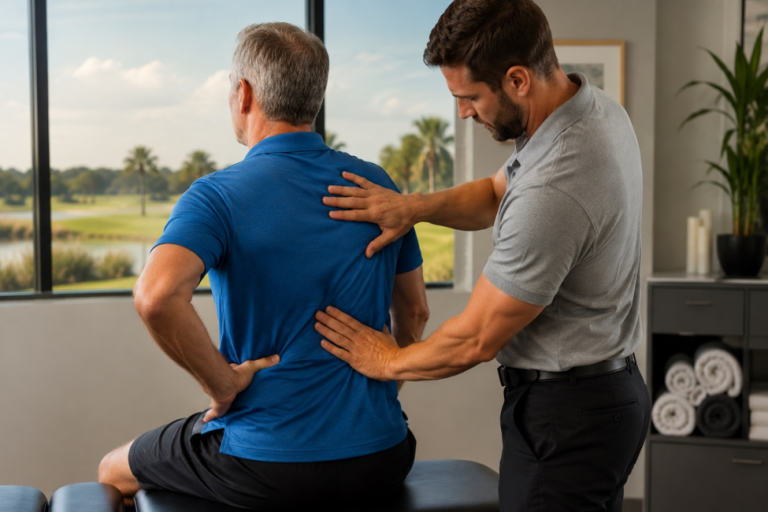
At Main Street Chiropractic, the first visit after a golf-related injury starts with a straightforward conversation about when the pain started, what it feels like during and after a swing, and which part of the game aggravates it most, the backswing, the downswing, or the follow-through. Doctors then assess spinal alignment, hip rotation, and shoulder mobility to identify exactly which structures are restricted or irritated.
This matters because two golfers who both describe “low back pain” can have completely different underlying causes, one from a disc issue and another from a simple joint restriction. Our sports injury treatment approach is built around finding that root cause rather than treating the pain generically, which is also why the recovery timeline below is a general guide rather than a fixed promise for every golfer.
A Realistic Recovery Timeline After a Golf Injury
Days 1 to 3: Early Evaluation and Pain Control
Patients should not wait more than three days after a golf injury to be seen. Waiting longer allows inflammation to set in and surrounding joints to stiffen in response, which can make the eventual recovery longer and more complicated. Same-day appointments are often available for golfers who reach out to our Hilton Head Island clinic right after a round leaves them sore.
During this early window, care typically focuses on calming inflammation and restoring basic pain-free movement. Class IV Laser Therapy is frequently used at this stage because it is a drug-free way to reduce pain and inflammation while promoting healing at the cellular level, and sessions usually last only five to ten minutes.
Weeks 1 to 4: Minor Strains and Joint Restrictions
Most minor golf-related strains and joint restrictions respond well to consistent chiropractic adjustments over two to four weeks. During this stretch, doctors typically combine spinal and hip adjustments with corrective exercises designed to rebuild stability in the muscles that support the swing, particularly through the core, hips, and shoulder girdle.
Golfers often notice the swing starting to feel more natural again during this window, with less guarding through the backswing and less soreness the day after playing. This is also when doctors begin reintroducing light practice, such as putting and short chipping, before a full return to the course.
Weeks 6 to 12: Complex Disc or Joint Injuries
Injuries involving multiple structures, such as a disc issue paired with hip or shoulder compensation, generally require a longer runway of six to twelve weeks. Doctors provide a clear, honest timeline after the initial assessment so golfers know what to expect rather than guessing at their own recovery.
This longer phase usually blends ongoing adjustments, Class IV Laser Therapy, and a progressive corrective exercise plan that gradually reintroduces rotational load. The goal throughout is to rebuild the swing on a stable foundation rather than rushing back to full competitive rounds too soon, which is one of the most common reasons golf injuries become recurring problems.
Golf Injury Prevention Tips for Hilton Head Island Golfers
- Warm up hips and thoracic spine rotation before the first tee, not just the driving range swing itself
- Build a consistent corrective exercise routine between rounds rather than only after pain appears
- Address a stiff hip or shoulder early instead of playing through it for several more rounds
- Consider a maintenance visit during peak golf season to keep the spine and hips moving well
When Golf-Related Pain Needs Medical Attention First
Most golf-related back, hip, and shoulder pain responds well to conservative chiropractic care, but certain symptoms should be evaluated by a medical doctor or emergency room before a chiropractic visit. These include sudden loss of bladder or bowel control, numbness in the groin or inner thighs, progressive weakness in one or both legs, or severe pain following a fall or collision on the course. Chiropractic care is a valuable part of recovery, but it works alongside medical care, not in place of it, when red-flag symptoms like these are present.
What Happens During Your First Visit for a Golf Injury?
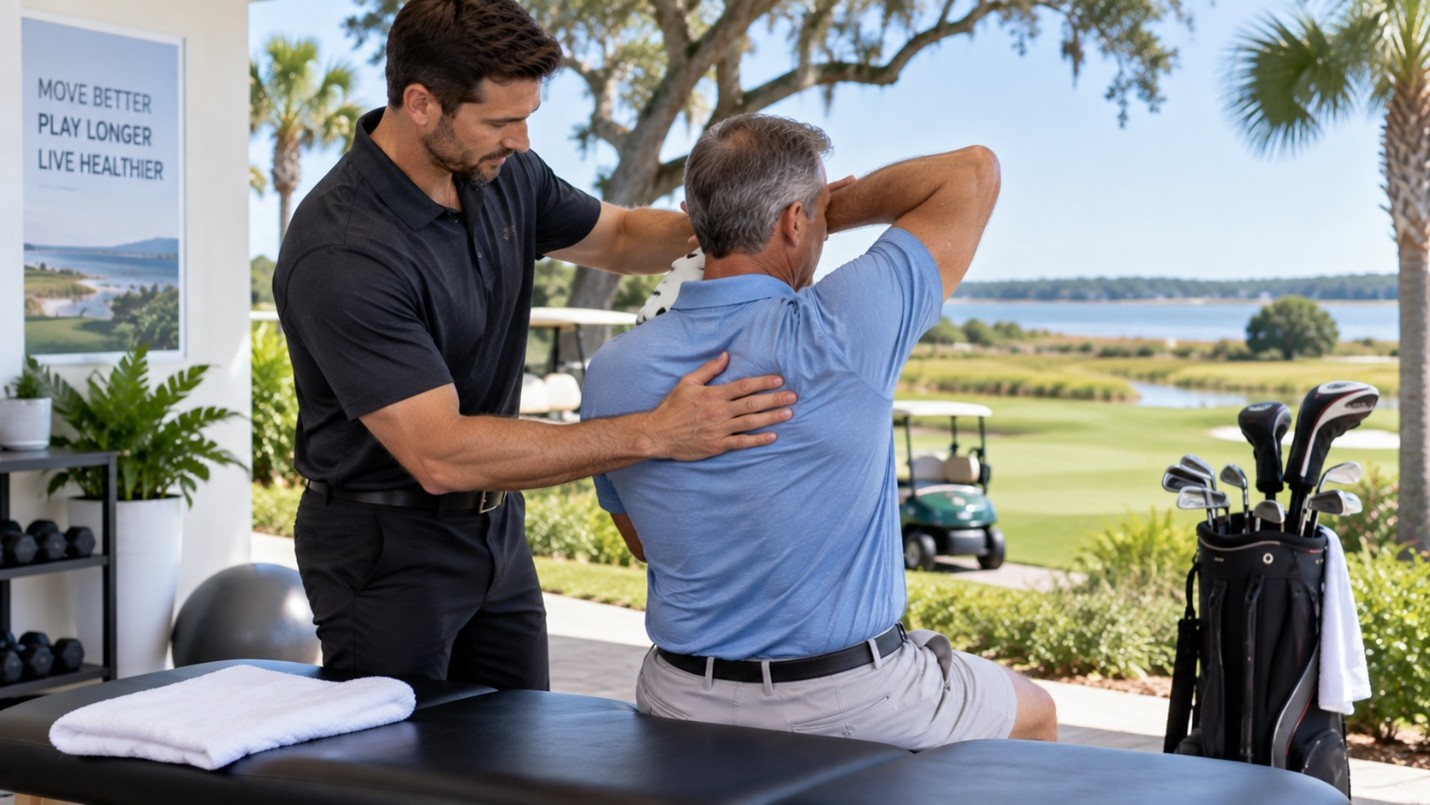
The first appointment starts with a conversation about the golfer’s history, current handicap-affecting pain, and specifically which part of the swing feels restricted or painful. Doctors will often ask a patient to demonstrate a slow-motion version of the backswing or follow-through in the office, since watching the movement in person reveals restrictions that are hard to describe in words alone.
From there, a hands-on assessment checks rotation through the thoracic spine, hip internal and external rotation on both sides, and shoulder mobility in the lead arm. It is common to find that one hip rotates noticeably less than the other, which forces the lower back or shoulder to compensate during every swing. Identifying that imbalance early is often the difference between a quick recovery and a nagging injury that keeps resurfacing season after season.
Can You Keep Playing Golf While Being Treated?
It depends on the severity of the injury, and doctors will give clear guidance rather than a blanket answer. For mild strains or restrictions, many golfers can continue playing at a reduced intensity, often skipping full-speed range sessions while continuing to putt and chip, as long as symptoms are not worsening after each round.
For more significant injuries, particularly disc-related pain or an acute shoulder strain, a short break from the course is usually recommended during the first one to two weeks of care so inflammation can settle before reintroducing rotational load. Pushing through pain at this stage tends to prolong recovery rather than shorten it, which is why doctors set expectations clearly at the first visit rather than leaving golfers to guess.
How Class IV Laser Therapy Supports Golf Injury Recovery
Class IV Laser Therapy, sometimes called Aspen Laser Therapy, is a drug-free, non-invasive treatment that delivers carefully calibrated infrared light to the injured area. This stimulates cellular regeneration, improves blood flow, and enhances tissue repair without the side effects that can come with medication. Golfers appreciate that treatment sessions are quick, usually lasting five to ten minutes, and most patients can resume normal daily activity shortly afterward.
For golf injuries specifically, this treatment is frequently paired with spinal and hip adjustments because it addresses inflammation directly at the source while the adjustment restores proper joint mechanics. Patients recovering from an athletic injury on Hilton Head Island often pair laser therapy with a broader sports injury treatment plan for faster, more complete results.
Get Back to the Course with a Personalized Plan
Whether the pain started after eighteen holes at a favorite Hilton Head Island course or has been building quietly over a full season of play, Main Street Chiropractic builds a personalized recovery plan around each golfer’s swing, schedule, and goals. Contact our Hilton Head Island team today to schedule a same-day evaluation and start working toward a stronger, more resilient swing.