Table Tennis Elbow and Wrist Pain: A Week-by-Week Recovery Guide for Hilton Head Players
Table tennis places repetitive stress on the wrist and elbow through fast, snapping strokes, which can lead to overuse injuries similar to tennis elbow. Main Street Chiropractic in Hilton Head Island treats these injuries with targeted adjustments, Class IV Laser Therapy, and a week-by-week recovery plan built around each player’s schedule.
Why Table Tennis Causes Elbow and Wrist Pain
Table tennis looks gentler than tennis or golf from the sidelines, but the wrist and forearm absorb an enormous number of quick, repetitive movements in a single match. Every topspin loop, backhand flick, and rapid rally places small amounts of strain on the tendons of the forearm and the small stabilizing joints of the wrist, and that strain accumulates match after match.
Over time, this repetitive stress can lead to the same type of tendon irritation seen in tennis elbow, along with wrist tendonitis, forearm tightness, and in some cases mild joint misalignment in the wrist or elbow. Players who recently increased how often they play, changed paddle grip or rubber, or added more topspin-heavy shots to their game often notice symptoms appear within a few weeks of that change.
What Does Table Tennis Elbow Feel Like?
- A dull ache or sharp twinge on the outside or inside of the elbow during play
- Wrist stiffness or soreness that is worse first thing in the morning
- Weaker grip strength when holding the paddle or opening a jar at home
- Pain that worsens with topspin strokes or fast backhand flicks specifically
How Main Street Chiropractic Approaches Table Tennis Injuries in Hilton Head Island SC
Doctors begin by assessing the elbow, wrist, and forearm together rather than treating the sore spot in isolation, since restricted movement further up the arm or through the shoulder can change how load travels down to the wrist during a stroke. This full picture helps identify whether the issue is primarily tendon irritation, a joint restriction, or a combination of both.
From there, a personalized plan typically combines precise adjustments to restore normal joint motion, Class IV Laser Therapy to calm inflammation and support tendon healing, and a corrective exercise program to rebuild strength in the forearm and wrist stabilizers. This mirrors the same approach used for sports injury treatment across other racquet and paddle sports on Hilton Head Island.
A Week-by-Week Recovery Guide
Week 1: Calm the Irritation
The first week typically focuses on reducing pain and inflammation rather than pushing through play. Class IV Laser Therapy sessions, usually five to ten minutes each, are often used during this window because the treatment is drug-free and non-invasive, and most players can resume normal daily activity shortly after each session. Reducing match frequency during this first week gives irritated tendons a real chance to settle down.
Weeks 2 to 3: Restore Motion and Begin Loading
Once the initial irritation has calmed, care shifts toward restoring full, pain-free motion in the wrist and elbow through adjustments and mobility work. Corrective exercises are introduced gradually to begin loading the forearm tendons in a controlled way, which helps them adapt and strengthen rather than staying fragile.
Many players can resume light, low-intensity practice during this stretch, focusing on soft shots and shorter rallies rather than full-speed topspin exchanges. Minor strains at this stage often follow the same two-to-four-week window seen with other overuse sports injuries.
Week 4 and Beyond: Return to Full Play
By the fourth week, most players with a straightforward case of table tennis elbow are ready to gradually reintroduce full-speed strokes, starting with backhand drives before layering topspin loops back in. More complex or long-standing cases, especially where wrist tendonitis has been present for months before treatment began, can take six to twelve weeks to fully resolve, similar to more complex injuries seen in other sports.
Can Table Tennis Elbow Come Back After Treatment?
It can, especially if the underlying grip, technique, or training load that caused it in the first place goes unchanged. That is why the recovery plan at Main Street Chiropractic always includes a maintenance and prevention component, not just pain relief. Simple habits, like warming up the wrist and forearm before play and easing back into topspin-heavy sessions after any break, go a long way toward keeping the issue from returning.
When to See a Chiropractor for Table Tennis Pain in Hilton Head Island SC
Players should not wait more than three days after noticing persistent elbow or wrist pain before scheduling an evaluation. Waiting longer allows inflammation to build and the surrounding joints to stiffen, which typically extends the overall recovery timeline. Same-day appointments are often available for players who reach out promptly.
How Is Table Tennis Elbow Different From Regular Tennis Elbow?
Table tennis elbow and regular tennis elbow involve the same tendons on the outside or inside of the elbow, but the mechanism of injury is slightly different. Tennis places heavier, slower load on the forearm through a full swinging motion, while table tennis relies on rapid, short, snapping strokes performed at a much higher repetition rate over the course of a match. This means table tennis players often develop symptoms from sheer repetition rather than from any single powerful stroke.
Because the paddle is lighter than a tennis racquet, some players assume the wrist and elbow are under less stress, but the speed and frequency of strokes in a fast rally can place a comparable cumulative load on the tendons over time. This is part of why doctors evaluate stroke frequency and playing volume, not just grip or equipment, when building a recovery and prevention plan.
Grip and Technique Adjustments That Help Prevent Recurrence
Once the initial pain has resolved, small adjustments to grip pressure and stroke technique can meaningfully reduce the chance of the injury returning. Gripping the paddle too tightly is one of the most common contributors to forearm tendon strain, since a tense grip transfers more shock directly into the wrist and elbow with every contact.
- Loosen grip pressure slightly, especially during long rallies or practice sessions
- Avoid stacking heavy topspin practice on consecutive days without a lighter recovery day between
- Warm up the wrist and forearm with light stretching before the first serve of the session
- Rotate practice focus between backhand and forehand strokes to avoid overloading one side
What to Expect at Your First Visit in Hilton Head Island SC
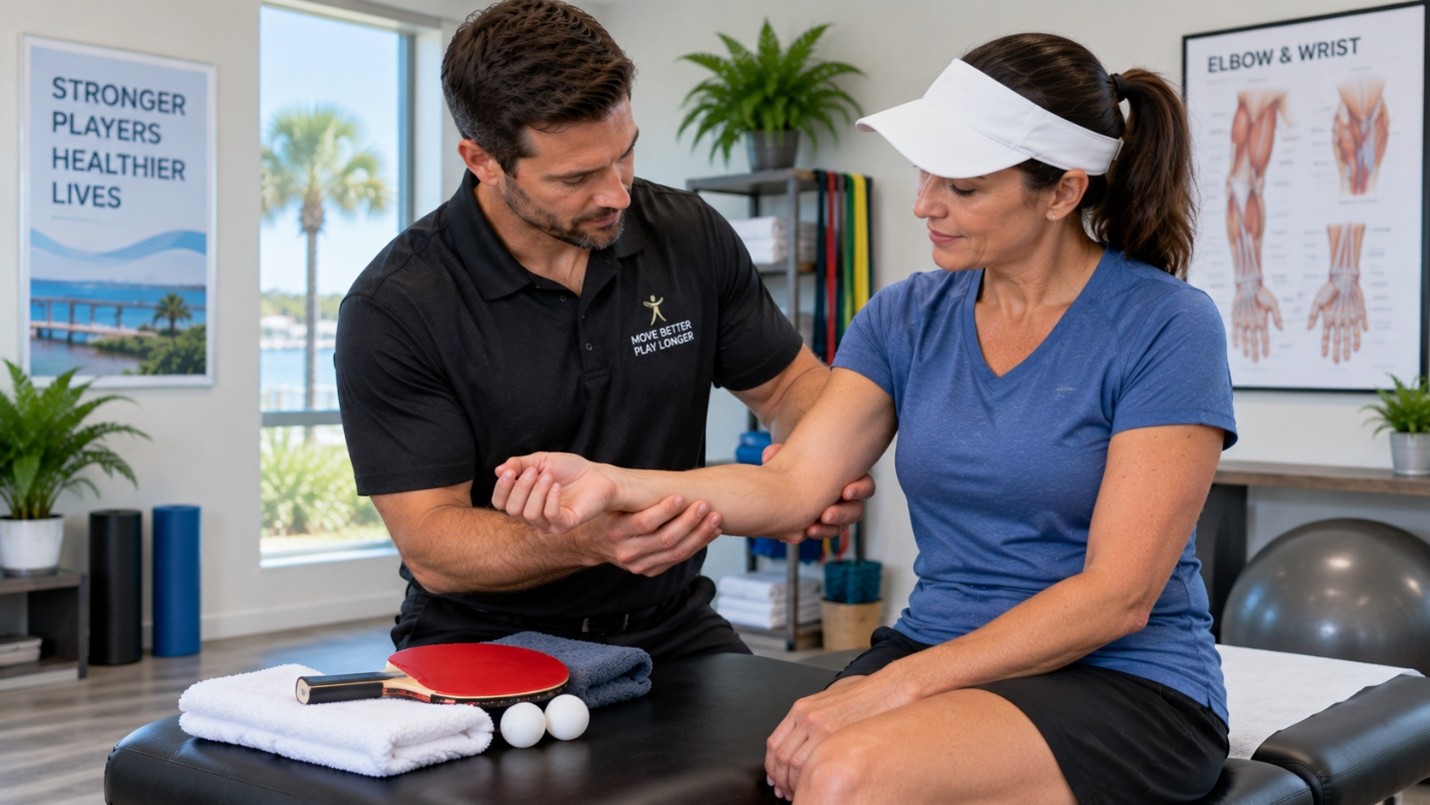
The first visit includes a hands-on assessment of the wrist, elbow, and forearm, along with questions about playing frequency, recent changes in equipment or technique, and how long the pain has been present. Doctors will often ask a player to demonstrate a stroke motion in the office to see exactly where in the movement the pain appears.
From there, a personalized plan is built around the player’s specific findings rather than a generic elbow protocol, combining adjustments, Class IV Laser Therapy, and a corrective exercise plan designed around the demands of table tennis specifically. Most players leave the first visit with a clear, realistic sense of what the next several weeks of recovery will look like.
How Corrective Exercise Rebuilds Wrist and Forearm Strength
Corrective exercise is one of the most important, and most often overlooked, parts of recovering from table tennis elbow. The right blueprint exercises strengthen the small stabilizing muscles of the forearm and wrist, which helps the tendons tolerate the repetitive stroke volume that table tennis demands without breaking back down under stress.
Doctors typically introduce these exercises gradually, starting with gentle isometric holds before progressing to controlled resistance movements as pain decreases. Patients who stay consistent with their exercise plan even after the pain resolves tend to see the lowest rates of recurrence, since strong, well-conditioned tendons handle the fast, repetitive nature of table tennis far better than weak or fatigued ones.
Equipment Considerations Worth Discussing With Your Doctor
Paddle weight, handle thickness, and rubber type can all influence how much strain the wrist and forearm absorb during play. A paddle that is too heavy or has an overly thin handle can force a tighter grip, which increases stress on the same tendons involved in table tennis elbow. Doctors sometimes discuss these equipment factors as part of a prevention plan, alongside the exercise and technique adjustments already covered.
Book a Same-Day Evaluation Today
Whether the discomfort started this week or has been nagging for months, our Hilton Head Island clinic can build a recovery plan tailored to the way you actually play. Contact Main Street Chiropractic to schedule a visit and get back to the table with less pain and more confidence in your stroke.