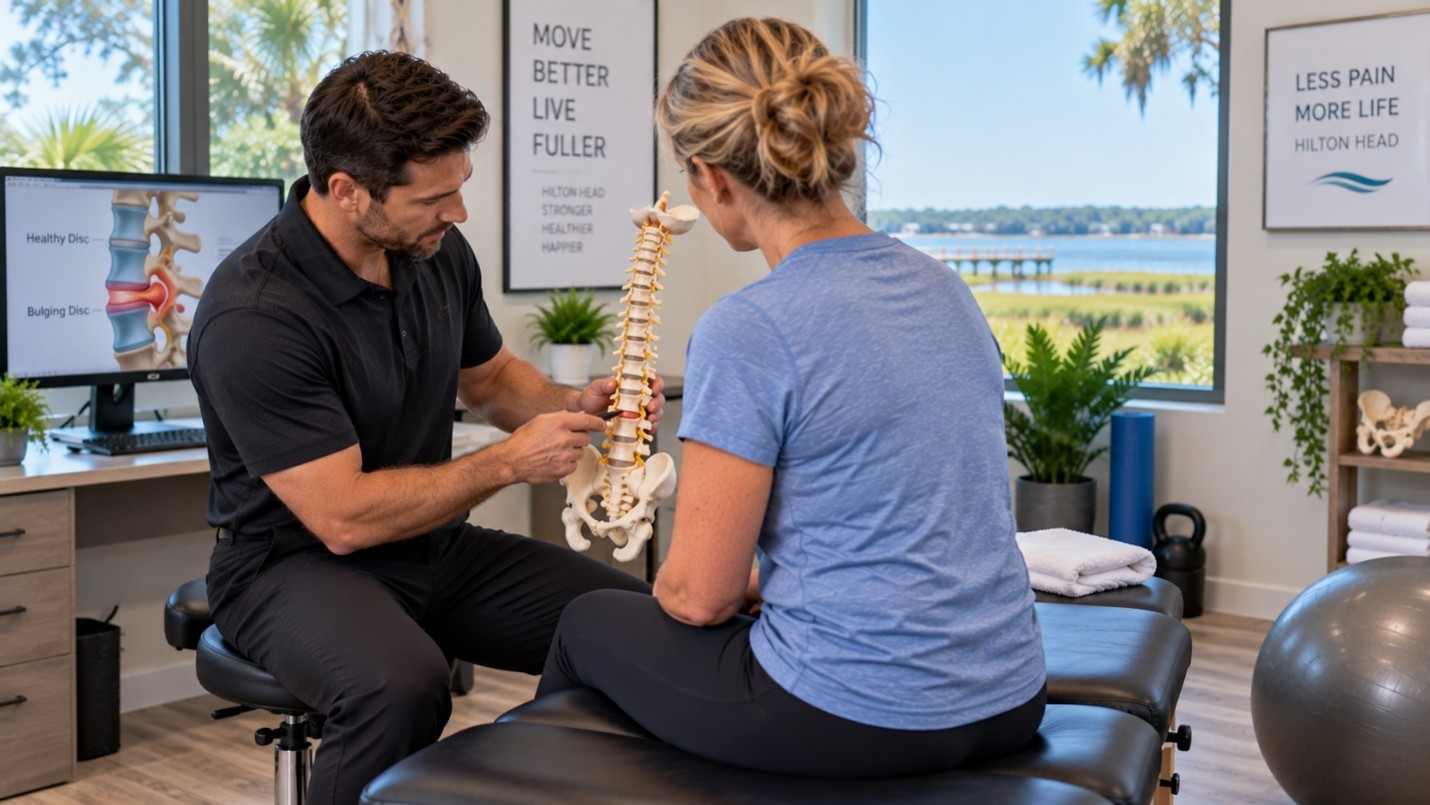
Bulging Disc in Hilton Head: Can Chiropractic Care Help You Avoid Surgery?
A bulging disc does not automatically mean surgery is the next step. Main Street Chiropractic in Hilton Head Island offers conservative back pain treatment, combining precise adjustments, Class IV Laser Therapy, and corrective exercise to relieve pressure and support healing for many bulging disc cases.
What Is a Bulging Disc?
The spine is cushioned by a series of discs that sit between each vertebra, acting as shock absorbers. A bulging disc occurs when the outer layer of one of these discs weakens and pushes outward beyond its normal boundary, without the inner material actually rupturing through, which is what distinguishes it from a full disc herniation. Both bulging discs and disc herniation are conditions our doctors regularly treat at Main Street Chiropractic in Hilton Head Island.
A bulging disc can develop gradually from years of poor posture, repetitive strain, or the natural wear of aging, or it can appear more suddenly after a car accident, an awkward lift, or a sports injury. Not every bulging disc causes symptoms, but when the bulge presses on a nearby nerve root, it can cause pain, numbness, tingling, or weakness that radiates from the low back into the hip and leg.
What Are the Symptoms of a Bulging Disc in the Lower Back?
- Lower back pain that worsens with sitting, bending, or lifting
- Pain, numbness, or tingling radiating into the hip, buttock, or leg
- Muscle weakness in the leg or foot on the affected side
- Pain that improves when lying down and worsens when upright for long periods
Do You Need Surgery for a Bulging Disc in Hilton Head Island SC?
Most bulging discs do not require surgery, and conservative care is typically recommended as the first course of action for patients without progressive neurological symptoms. Surgery is generally reserved for cases where conservative treatment has failed over a meaningful period of time, or where symptoms are severe and progressively worsening. This is why many patients start with chiropractic care before considering more invasive options.
At Main Street Chiropractic, doctors evaluate the location and severity of the bulge, the specific nerve involvement, and how the pain responds to movement to help determine whether conservative care is a reasonable starting point. This evaluation also helps identify the small number of cases where a medical doctor or spine specialist should be involved right away.
How Chiropractic Care Approaches a Bulging Disc
Care for a bulging disc typically combines several elements working together rather than a single technique. Precise, targeted adjustments aim to relieve pressure on the affected nerve root and restore more normal movement to the surrounding joints. Class IV Laser Therapy is often layered in to help reduce inflammation and support tissue healing at the site of irritation, using calibrated infrared light rather than medication or invasive procedures.
Corrective exercises round out the plan, helping strengthen the muscles that support the spine so that the disc is under less repetitive stress going forward. This combination mirrors the same comprehensive approach used across our back pain treatment and pain management services for patients throughout Hilton Head Island, Bluffton, and Beaufort.
How Long Does It Take to Recover From a Bulging Disc?
Recovery timelines vary depending on the severity of the bulge and how long symptoms have been present before treatment begins. Many patients with a straightforward bulging disc notice meaningful improvement within a few weeks of consistent care, similar to the two-to-four-week window seen with other moderate spinal injuries. More long-standing or complex cases, particularly where nerve involvement has been present for months, can take six to twelve weeks or longer of steady treatment.
Doctors provide a clear, honest assessment after the first visit so patients know what a realistic recovery looks like for their specific situation, rather than a one-size-fits-all estimate.
When a Bulging Disc Needs Medical Attention First
Certain symptoms should be evaluated by a medical doctor or emergency room before starting chiropractic care. These red-flag symptoms include sudden loss of bladder or bowel control, numbness in the groin or inner thighs, and progressive weakness in one or both legs that continues to worsen. These can indicate significant nerve compression that requires prompt medical evaluation, and chiropractic care is not appropriate as a first step when these symptoms are present.
For the large majority of bulging disc cases without these red-flag symptoms, conservative chiropractic care remains a reasonable and often effective first option before considering more invasive treatment.
What Causes a Bulging Disc in the First Place?
Discs naturally lose some hydration and elasticity with age, which makes the outer layer more prone to bulging under everyday stress. Years of poor sitting posture, repetitive bending or twisting at work, and carrying extra body weight all add cumulative pressure to the lower back discs over time. In many cases, a bulging disc has actually been developing quietly for years before a single awkward lift or minor fall finally causes noticeable symptoms.
Sudden causes are also common, particularly car accidents, sports injuries, and heavy lifting with poor form. Whatever the original cause, the underlying mechanical stress on the disc needs to be addressed as part of recovery, not just the resulting pain, which is why doctors look closely at posture, movement patterns, and daily habits during the evaluation.
How Is a Bulging Disc Diagnosed in Hilton Head Island SC?
Doctors begin with a detailed history and a hands-on physical examination, checking reflexes, strength, and sensation in the legs to identify whether a nerve root is being affected and, if so, which one. Specific movement and orthopedic tests can often reproduce or relieve symptoms in a way that points toward a disc issue rather than a purely muscular strain.
When imaging such as an MRI has already been obtained by a medical doctor, doctors incorporate those findings into the treatment plan. When no imaging exists yet, a chiropractic evaluation can still provide meaningful information about severity and appropriate next steps, and a referral for imaging is made when the clinical picture calls for it.
Everyday Habits That Support Recovery From a Bulging Disc
- Avoid prolonged sitting; take short standing or walking breaks every thirty to sixty minutes
- Practice proper lifting mechanics, bending at the hips and knees rather than the lower back
- Sleep with a pillow between the knees when lying on your side to keep the spine neutral
- Stay consistent with prescribed corrective exercises, even once pain starts to improve
Bulging Disc vs. Herniated Disc: What Is the Difference?
The terms bulging disc and herniated disc are often used interchangeably by patients, but they describe two different stages of disc injury. A bulging disc involves the outer layer stretching and pushing outward while remaining intact, similar to a tire bulging under pressure without going flat. A herniated disc, sometimes called a slipped or ruptured disc, occurs when that outer layer actually tears, allowing the inner material to escape and press more directly on nearby nerve structures.
In general, a bulging disc tends to cause milder symptoms and often responds well to conservative care, while a herniated disc can sometimes involve more intense nerve irritation. That said, both conditions exist on a spectrum, and doctors at Main Street Chiropractic evaluate the specific severity of each case rather than assuming symptoms based on terminology alone.
Can a Bulging Disc Heal on Its Own?
In some cases, mild bulging discs improve gradually on their own as the body reabsorbs some of the displaced disc material and inflammation subsides over time. However, relying on this alone is unpredictable, and the underlying postural and movement patterns that contributed to the bulge in the first place typically remain unaddressed without any intervention.
This is why doctors generally recommend an active, structured approach rather than a wait-and-see one, particularly when symptoms are already affecting daily activities like sitting, working, driving, or sleeping through the night. Combining hands-on care with the everyday habits outlined above gives the disc the best possible environment to heal while also correcting the mechanical stress that caused the problem in the first place.
Talk to a Hilton Head Island Doctor About Your Bulging Disc
If you have been diagnosed with a bulging disc, or you are dealing with low back pain that radiates into your hip or leg, Main Street Chiropractic can help you understand your conservative care options before surgery becomes the conversation. Contact our Hilton Head Island clinic today to schedule an evaluation with one of our doctors.