Class IV Laser Therapy for Knee Pain and Arthritis in Hilton Head Island, SC: Does It Really Work?
Laser therapy for knee pain may offer short-term pain relief for some people with knee osteoarthritis, but research results are mixed and it does not rebuild cartilage. It tends to be most useful as one part of a plan that includes exercise and weight management. Learn more about our knee pain treatment and how Class IV laser and pain management fit together.
Does Laser Therapy Really Work for Knee Pain?
Laser therapy may reduce knee osteoarthritis pain for some people in the short term, but the evidence is mixed and results vary. The most encouraging data come from a 2019 systematic review and meta-analysis in BMJ Open by Stausholm and colleagues. It pooled 22 randomized, placebo-controlled trials with 1,063 participants and found that low-level laser therapy at recommended doses reduced pain and disability compared with placebo, with effects measured up to 12 weeks after treatment ended. Not every study agrees. A 2014 randomized trial in JAMA by Hinman and colleagues found that laser acupuncture was no better than sham laser for chronic knee pain in adults 50 and older. Differences in dose, wavelength, and treatment sites likely explain part of the gap. Laser therapy is a reasonable option to discuss, not a stand-alone answer for arthritic knees.
How Does Class IV Laser Therapy Work on the Knee?
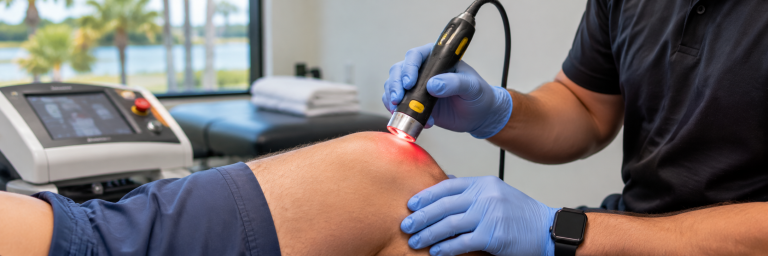
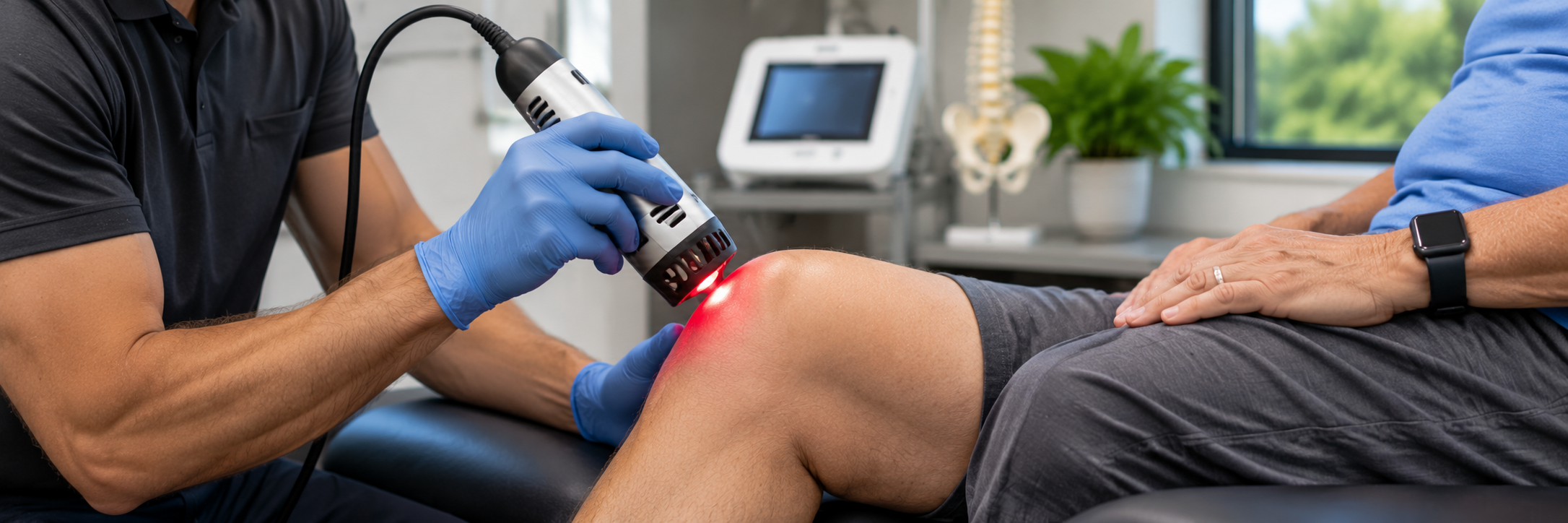
Class IV laser therapy uses concentrated near-infrared light to deliver energy into the tissues around the knee, a process called photobiomodulation. Researchers believe the light is absorbed by cells and may influence inflammation, local circulation, and pain signaling, although the exact mechanisms are still being studied. Class IV devices operate above 500 milliwatts, more power than the low-level lasers used in many knee studies, and they often produce a gentle warming sensation. In the United States, these devices are FDA-cleared through the 510(k) process, typically for temporary relief of minor muscle and joint pain, stiffness, and increasing local circulation. Clearance is not the same as approval, and it does not mean the device treats arthritis itself. Our overview of Class IV laser therapy for chronic pain explains sessions, safety, and candidates in more detail.
What Does the Research Say About Laser Dose and Knee Osteoarthritis?
Dose appears to matter more than raw power. The 2019 BMJ Open review found benefits when trials used recommended doses, such as 4 to 8 joules per treatment spot at 785 to 860 nanometer wavelengths, or 1 to 3 joules per spot at 904 nanometers. Pain relief peaked around 2 to 4 weeks after the treatment course, and no adverse events were reported in the included trials. Most of those studies used low-level lasers, so the findings do not automatically transfer to higher-power Class IV devices, and more power has not been proven to work better. Guidelines are also cautious. The 2019 American College of Rheumatology and Arthritis Foundation osteoarthritis guideline strongly recommends exercise, weight loss for people with overweight, tai chi, and self-management programs, and laser therapy is not among its recommended treatments. That is why laser therapy should support, not replace, those core steps.
What Can Laser Therapy Not Do for Arthritic Knees?
Laser therapy does not regrow cartilage, reverse osteoarthritis, or correct joint alignment, and no reliable study shows that it does. At most, it may ease pain and stiffness for a period of time, which can make it easier to stay active and complete an exercise program. It is not a substitute for a medical evaluation when the knee is badly swollen, unstable, or getting steadily worse, and it does not replace options your physician may discuss, such as medication, injections, or a surgical referral for advanced joint damage. Laser therapy is also not right for everyone. Protective eyewear is required during treatment, and a provider should screen for conditions that make it inappropriate. Laser treatment is generally avoided or modified in these situations.
• Over a known or suspected cancer
• Over the abdomen or low back during pregnancy
• Over or near the eyes or the thyroid gland
• When taking medications that increase sensitivity to light
• Over areas with reduced sensation, unless the provider adjusts settings
Why Combine Laser Therapy With Exercise for Knee Pain in Hilton Head Island?
Exercise has the strongest evidence for knee osteoarthritis, so most plans that include laser therapy should also include strengthening and movement. Stronger quadriceps, hip, and core muscles help absorb load across the knee, and regular activity supports joint health and weight management. On Hilton Head Island and in Bluffton, that might mean biking the leisure paths, walking on firm sand at low tide, swimming, or easing back into pickleball, tennis, and golf. Laser therapy may help some people get through the early, more painful weeks of an exercise program. Our corrective exercises focus on strength, balance, and movement patterns, and our article on pickleball, tennis, and running injuries covers ways to return to court sports safely. Progress gradually, expect mild soreness as you build strength, and report sharp pain, swelling, or giving way.
When Should Knee Pain Be Checked by a Doctor?
Some knee symptoms point to problems that laser therapy or chiropractic care should not treat first. Infection, gout, fractures, significant ligament or meniscus tears, and blood clots in the leg all need prompt medical evaluation. Older adults, people with diabetes, and anyone who recently had a joint injection or surgery should be especially careful about a hot, swollen joint. If you have had a knee replacement, check with your surgeon before any new treatment over the joint. When in doubt, it is safer to be examined by a physician, an urgent care clinic, or an emergency department first, and then return to conservative care once serious causes are ruled out. Seek medical care promptly if you notice any of the following.
• A hot, red, swollen knee, especially with fever or chills
• A knee that locks, catches, or gives way
• Inability to bear weight or take four steps after an injury
• Rapid swelling or a pop at the time of injury
• Calf pain, swelling, or warmth, which can signal a blood clot
• Visible deformity, numbness, or a cold or pale foot
How Can Main Street Chiropractic Help With Knee Pain in Hilton Head Island, SC?
Main Street Chiropractic brings more than a decade of experience to helping patients with knee pain stay active. Care starts with a health history and exam before any treatment, so we can decide whether Class IV laser therapy, exercise, extremity care, or a referral fits your situation. When symptoms suggest a problem that needs imaging or medical treatment, our chiropractor coordinates with your physician. We will also explain the limits of laser therapy honestly, because results vary. We serve patients from Hilton Head Island, Bluffton, and Sun City, and most major insurance plans are accepted, so ask about yours. Visit us at 92 Main Street, Suite D, Hilton Head Island, SC 29926, call 843-342-3333, or request a visit through our online scheduling page. This article is for general information and is not medical advice.
Frequently Asked Questions About Laser Therapy for Knee Pain
There is no fixed number. Studies of knee osteoarthritis often used several sessions spread over a few weeks, and benefits in some trials peaked a few weeks after the course ended. Your plan should depend on your symptoms and response, with a reassessment along the way. If you see no meaningful change after a reasonable trial, it makes sense to stop and consider other options.
Most people describe a gentle warmth rather than pain. Because Class IV lasers deliver more power than low-level lasers, the provider keeps the handpiece moving and adjusts settings to avoid overheating the skin. Tell the provider right away if the area feels too hot. Everyone in the room wears protective eyewear, since laser light can damage the eyes.
Research on laser therapy after knee replacement is limited, so talk with your orthopedic surgeon before any treatment over the joint. Recovery after a replacement depends mainly on physical therapy, gradual strengthening, and following your surgeon’s instructions. New warmth, redness, drainage, or fever around a replaced knee can signal infection and needs prompt medical attention, not laser treatment.
Coverage varies by plan. Many insurers consider laser therapy for musculoskeletal pain investigational, and Original Medicare does not cover chiropractic services other than manual manipulation of the spine. Ask our office whether your plan, including Medicare, applies before starting care, and ask about costs up front so you can decide whether a trial of laser therapy makes sense for you.
There is little research on laser therapy for meniscus tears. A knee that locks, catches, or gives way after a twisting injury should be evaluated by a physician, and imaging may be needed. Many degenerative meniscus tears in older adults are managed with exercise therapy first. Laser therapy might ease pain for some people, but it does not repair torn tissue.
With proper screening, laser therapy is generally considered low risk, and the 2019 BMJ Open review reported no adverse events in its included trials. The main precautions are eye protection, avoiding treatment over cancer or over the abdomen during pregnancy, and caution with light-sensitizing medications. Class IV lasers can also heat the skin, so settings and technique matter.